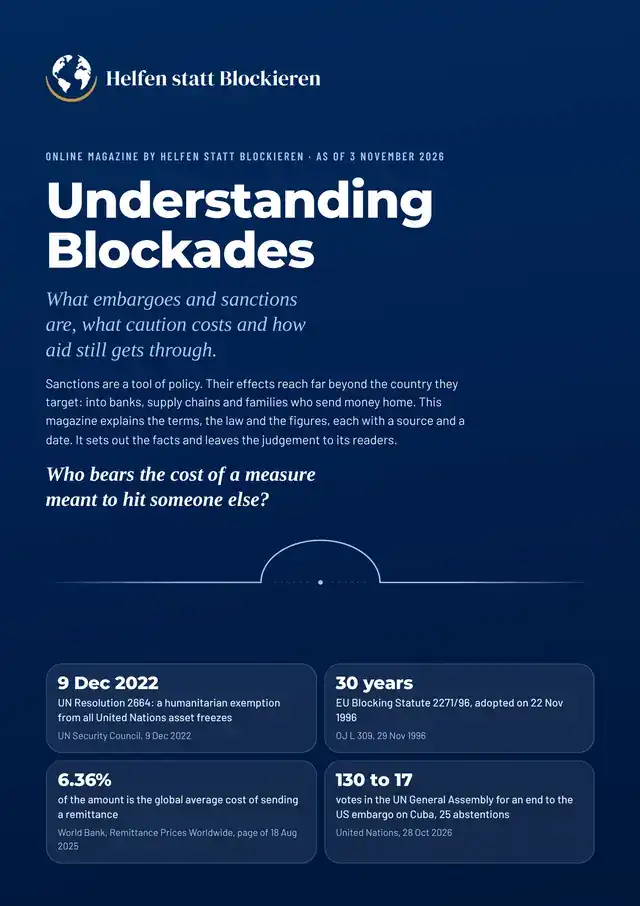
A situation report in eight chapters: how the world economy is doing in autumn 2026, which blockades are in effect, what they do in the Americas, Europe, Russia, China, Asia, the Gulf, Africa and Cuba, what money, law and labour need, and which paths the …
Article · · Helfen statt Blockieren editorial team
Anyone working with property that Cuba expropriated after 1959 can be sued in the United States, including European companies. Two Supreme Court rulings made such suits easier in 2026. This article explains what has changed, who sues, and what the EU Blocking …
Topic page · · Helfen statt Blockieren editorial team
On Cuba this website always names two halves: the US embargo and the failure of the Cuban leadership. Until now the second half appeared in subordinate clauses. This page brings together what independent bodies find on political prisoners, releases and …
Lead articles
Five lead articles tell the connections, from the question of who blocks to the case of Cuba 2026. The path with all sources is at Knowledge in seven steps.
Lead article · · Helfen statt Blockieren editorial team
In 1950, 18 sanctions cases were in force worldwide; in 2023 there were 615. Most are imposed by the United States, but the EU, the United Kingdom, Russia and China also sanction more than they used to. This lead article puts the time series in context: who …
Lead article · · Helfen statt Blockieren editorial team
A blockade begins with a text: a law, a list, an order. Before it reaches a family, it passes through banks, insurers, shipping lines and suppliers. This lead article follows that path station by station, says whom it hits and what it costs, and separates …
Lead article · · Helfen statt Blockieren editorial team
Food, medicines and humanitarian aid are exempt in almost all sanctions programmes. Even so, they often fail to arrive. The reason is rarely a ban. It lies in conditions, in the caution of banks and suppliers and in obstacles within the target country itself. …
Lead article · · Helfen statt Blockieren editorial team
A trader in Leipzig can do little about a law passed in Washington, Brussels or Moscow. Almost anyone can do something about the gap between “permitted” and “arrived”. An overview by role: what the law already offers today, what it costs and where it does not …
Lead article · · Helfen statt Blockieren editorial team
Each year Helfen statt Blockieren puts one case at the centre. In 2026 it is Cuba: with one of the oldest embargoes still in force and with a leadership that builds obstacles of its own and holds people for political reasons. This lead article shows how the …
A situation report in eight chapters: how the world economy is doing in autumn 2026, which blockades are in effect, what they do in the Americas, Europe, Russia, China, Asia, the Gulf, Africa and Cuba, what money, law and labour need, and which paths the …
Economy and the world · · Helfen statt Blockieren editorial team
World trade is growing despite tariffs, sanctions and war in the Gulf: according to UNCTAD it reached 35 trillion US dollars in 2025, and the WTO expects merchandise volumes to rise by 3.9 percent in 2026. At the same time, global uncertainty is higher than …
Economy and the world · · Helfen statt Blockieren editorial team
Few large economies depend on world trade as much as Germany: imports and exports together equal almost 80 percent of output, against a quarter in the United States. Yet Germany’s share of world merchandise exports has fallen from 8.5 to 6.7 percent since …
Economy and the world · · Helfen statt Blockieren editorial team
Whether a small trader, a mid-sized exporter or a corporation: what firms need first is predictability. 83 percent of EU firms call uncertainty a barrier to investment. Then come payments that arrive, finance that does not fail because of size, and law that …
Economy and the world · · Helfen statt Blockieren editorial team
The EU adopts sanctions in quick succession, 21 packages against Russia alone. Yet it hardly enforces the protection of its firms against third-country sanctions: the Blocking Statute turns thirty on 22 November 2026, and the Commission receives on average 24 …
Economy and the world · · Helfen statt Blockieren editorial team
Is the world economy splitting into blocs, and what would that cost? The IMF, the WTO, the ECB, the World Bank and the Kiel Institute have calculated scenarios. This analysis sets their ranges side by side, from 0.2 to 9 percent of world output, shows how the …
People and the world
People and the world · · Helfen statt Blockieren editorial team
Sanctions are usually measured in trade figures. Yet they also act at the workplace: on the bank analyst who decides on a transfer, on the exporter who does not know whether his delivery will remain permitted, and on the doctor who lacks a medicine. What …
People and the world · · Helfen statt Blockieren editorial team
No law forbids a bank to carry out a permitted transfer. Even so, banks have for years been withdrawing from whole regions and groups of customers. Central bank data show how far this retreat reaches, who feels it and why for banks it is often the simplest …
People and the world · · Helfen statt Blockieren editorial team
On 9 December 2022 the UN Security Council decided that humanitarian aid is exempt from all United Nations asset freezes. Almost four years later it is possible to say what the resolution has achieved: more legal certainty, individual breakthroughs on the …
People and the world · · Helfen statt Blockieren editorial team
Most sanctions are decided in Washington, Brussels and New York. Many of the people who live with their consequences live in Latin America, Africa, Asia and the Middle East. How large the costs are is disputed in research. What is certain is where they arise: …
People and the world · · Helfen statt Blockieren editorial team
Since 2022 the US has blocked high-performance chips and equipment for China. China responds with controls on raw materials it supplies almost alone. The EU is trying to free itself from the squeeze. In between are firms that need magnets, light-emitting …
Short study · · Helfen statt Blockieren editorial team
A stocktake in ten sections. What strains do sanctions create for workers in the countries that impose them and in the countries they hit? What of this is shown, how strongly, and what has nobody studied? With tables of effects, levels of evidence and a list …
Law
Explainer · · Helfen statt Blockieren editorial team
May a state or the EU block trade and payments with another state without a decision of the UN Security Council? The answer depends on whom you ask. This article sorts the three common readings, names who holds them, and shows what courts have decided so far …
Article · · Helfen statt Blockieren editorial team
Anyone working with property that Cuba expropriated after 1959 can be sued in the United States, including European companies. Two Supreme Court rulings made such suits easier in 2026. This article explains what has changed, who sues, and what the EU Blocking …
Explainer · · Helfen statt Blockieren editorial team
Most sanctions today hit not whole countries but names: people, companies, ships. Anyone on a list loses access to accounts and business, often without a trial. This article explains how one ends up on a list, how to fight it, how often that succeeds, and …
Explainer · · Helfen statt Blockieren editorial team
A sanction in peacetime and a blockade in war often share a word but follow different law. This article first explains the rules that protect civilians from hunger in armed conflict, and then how independent experts assess the situation in Gaza and Sudan and …
Data and research
Literature review · · Helfen statt Blockieren editorial team
Hardly any figure shapes the sanctions debate as strongly as this one: more than half a million people die every year from their consequences. It comes from a peer-reviewed study. Another study reaches the opposite result on one important question, and the …
Literature review · · Helfen statt Blockieren editorial team
A third, five percent or more than half: depending on the study, sanctions succeed rarely or often. Showing only the costs and never the aims is as far from neutral as showing only the aims. This review puts the main counts side by side, explains why they …
Countries and cases
Topic page · · Helfen statt Blockieren editorial team
On Cuba this website always names two halves: the US embargo and the failure of the Cuban leadership. Until now the second half appeared in subordinate clauses. This page brings together what independent bodies find on political prisoners, releases and …
Case study · · Helfen statt Blockieren editorial team
Since May 2025 the EU and the United States have lifted their economic sanctions on Syria step by step. Money and trade are still arriving only slowly. The case shows that lifting works more slowly than imposing, and that besides the law, the caution of banks …
History
History · · Helfen statt Blockieren editorial team
On 21 November 1806 Napoleon declared the British Isles blockaded from Berlin and banned all trade with them. On Saturday, 21 November 2026, in the middle of the week “Helfen statt Blockieren”, the Berlin Decree turns 220. A walk through two centuries of …
For schools
For schools · · Helfen statt Blockieren editorial team
Sanctions are a topic on which thoughtful people reach opposite judgements. This teaching pack for politics, economics, history and ethics in lower and upper secondary school helps to teach it as a controversy without overwhelming students: four units of 90 …
Sanctions and blockades are decided in capitals, but their costs arise at the kitchen table, in the workshop and on the corporate balance sheet. This piece sets out what research knows about the effects, for the target country and for the country imposing …
Since 2022 Germany has been the weakest large growth case in the EU. How much of this is due to sanctions and counter-sanctions is the question most often asked and least often answered cleanly. This piece separates what is established from what remains …
A conjecture that we examine openly here, without endorsing it: crises and sanctions have steered money away from small business owners, GDP grows mainly through richer corporations and debt-financed public spending, and therefore misrepresents the situation. …
Article · · Helfen statt Blockieren editorial team
Since summer 2025 the United States has reorganised its tariffs on goods from the EU several times: by agreement, after a court ruling and on a new legal basis. For a company that ships goods this mainly means recalculating, redeclaring and replanning. An …
Short study · · Helfen statt Blockieren editorial team
Since 2025 new US tariffs have applied to goods from the EU, and the rules have changed several times since. This short study compares German exports to the US from January to August 2024, the last full comparison period before the tariffs, with the same …
Explainer · · Helfen statt Blockieren editorial team
The invoice has been paid, but the money does not arrive. Often there is no prohibition behind it, but a check that raises an alert, or a bank that would rather refuse than examine. This is the path of a payment and of a shipment through sanctions screening, …
Article · · Helfen statt Blockieren editorial team
According to the government, Cuba now has 15,200 private small and medium-sized enterprises. They buy food, building materials and spare parts abroad. EU exports to Cuba, by contrast, have fallen by more than two fifths since 2015. What holds back permitted …
Idea and proposal · · Helfen statt Blockieren editorial team
Many refusals happen because a bank cannot tell quickly that a deal is permitted. Our proposal: a short file per deal, always built the same way, that makes checking easy, and a shared procedure for the cases where things still get stuck. A working draft for …
On 22 November 1996 the Council of the European Union adopted a regulation against the effects of foreign sanctions laws. It is still in force, yet rarely applied. Taking stock on the anniversary.
In 2026 the US tightened its measures against Cuba. At the same time hardship in the country is growing for reasons that do not come from outside as well. An overview that shows both.
Briefings for companies
Short and with sources: one question, what is new in 2026, three checkpoints for your own company. The briefings are not legal or sanctions advice on individual cases.
Anyone supplying third countries in 2026 needs to know more precisely where the goods end up. In October the EU adopted its largest listing round so far, and since February sanctions breaches carry heavier criminal penalties in Germany. A situation report for companies without their own sanctions department.
Many companies experience sanctions not as a ban but as a transfer that never arrives. In 2026 the European Court of Justice drew a line, while the United States extended its lists to new targets. A situation report on banks, accounts and third-country lists.
On 10 November 2026, China’s suspension of tighter export controls on rare earths, batteries and superhard materials expires. Almost at the same time, a new version of the EU list of dual-use items enters into force. A situation report for companies working with magnets, electronics or batteries.
In 2026 the United States authorised business with Venezuela and, for a time, with Iran by general licence. For companies in the EU this means little as long as EU law and the licence conditions do not fit. A situation report on two countries moving in opposite directions.
In 2026 the EU substantially scaled back its supply chain law, Germany plans to abolish the reporting duty under its own act, and the carbon border adjustment entered its definitive phase. A situation report on what companies still have to do.
The magazine “Blockaden verstehen”
Helfen statt Blockieren: the magazine about blockades